
 By
A professional dental cleaning is a health appointment built around prevention rather than repair. For anyone whose calendar runs in tight blocks, that prevention has a measurable value. The questions asked before booking decide how much of it a patient keeps.
Table of Contents
The cost of skipping a routine cleaning
Dentists call a routine cleaning prophylaxis. The term signals intent: the appointment exists to stop periodontal disease before it starts.
Plaque left on enamel hardens into calculus, a mineral deposit that home brushing cannot remove. Only professional scaling instruments remove it. Calculus also forms below the gumline, where it feeds the chronic inflammation that damages soft tissue and bone.
Periodontal disease rarely hurts in its early stages, and the damage accumulates while nothing feels wrong.
When prevention fails, the costs multiply. An abscessed tooth can mean urgent treatment followed by a specialist referral, with recovery time that lands mid-week. None of it schedules itself around a deadline.
The stakes reach past the mouth. Researchers have linked poor oral health to cardiovascular disease and diabetes, which suggests gum health reflects more than what happens between the teeth. A cleaning is a small intervention that may have broad effects.
The productivity argument is just as concrete. Unplanned dental visits can disrupt a working day. A scheduled cleaning happens at a chosen time; an abscess picks its own.
What does the appointment actually include?
The word cleaning covers a wide range of services. Some appointments are full clinical procedures. Others amount to a cosmetic polish and little else. A polish brightens the visible surfaces and skips everything below the gumline.
A thorough session includes scaling to clear calculus, polishing, a periodontal pocket depth check, and an oral cancer screening. The pocket check measures the space between gum and tooth at several points per tooth, and readings that climb over time flag early disease. The screening examines the tongue, cheeks, palate, and floor of the mouth for tissue changes a patient would never notice.
Polishing serves a clinical purpose as well. Smooth enamel may give new plaque less grip, which can slow deposit buildup between visits.
Ask whether the practice uses ultrasonic scalers. These instruments vibrate at high frequency and break down heavy deposits faster than hand instruments alone. For anyone watching the clock, that means less time in the chair.
The question is easy to put to the receptionist at booking. Ask what the appointment covers and how much time the practice sets aside for it. A vague answer usually signals a polish-only visit.
How current is the diagnostic equipment?
The imaging in the room determines how quickly a dentist can diagnose a problem. Two questions cover it before booking.
Ask about digital radiography first. Digital X-rays appear on screen within moments and expose patients to significantly less radiation than traditional film. The lower dose matters for patients who need images taken regularly to monitor a known problem. Bitewing X-rays, the standard views of the back teeth, reveal decay between molars and track bone levels around them.
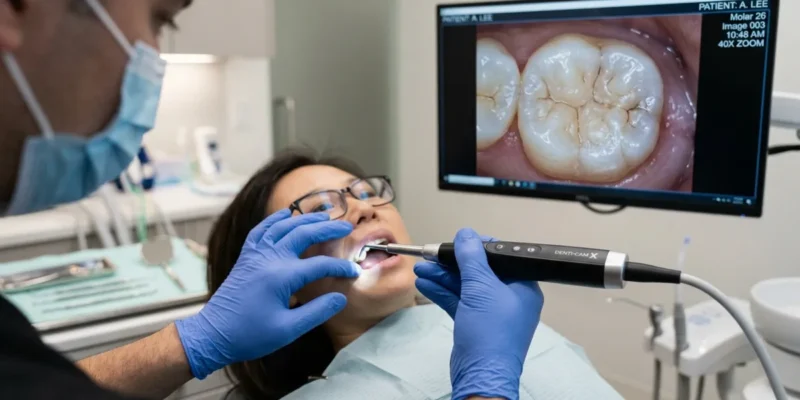
Then ask about intraoral cameras. A handheld camera shows the patient exactly what the dentist sees, in high resolution, on a chairside screen. A cracked filling stops being an abstract claim and becomes a photograph. Patients who can see the problem tend to make faster decisions about treatment.
These images build a record over time. Comparing this year’s X-rays with last year’s shows whether a worn area or a deep pocket is stable or progressing. Decay caught between teeth at this stage can mean a smaller filling and a shorter appointment.
Digital files have one more advantage. They transfer instantly if a specialist referral or a second opinion is ever needed.
Will the appointment fit the working week?
Scheduling problems are one common reason people miss cleanings. A practice that respects a work calendar can remove much of that barrier.
Ask about appointments before or after standard hours, and whether the books open on weekends. Ask whether intake forms can be completed online before arrival. That way the visit starts at the chair. A medical history finished at home the night before removes the slowest part of check-in.
Punctuality is worth asking about directly. A clinic that runs on time treats the appointment as the booking states, and waiting room minutes are the hidden cost of any midday visit. Reception staff will usually say honestly whether the schedule holds.
Some practices also offer teledentistry triage. A short virtual consult can decide whether a chipped tooth or a lost filling needs an urgent chair or a routine one. Triage like this can help prevent both unnecessary visits and dangerous delays.
Location matters too. A clinic near home or the commute route turns a hygiene visit into a short errand instead of a half-day absence. A commuter in Hobart’s northern suburbs might shortlist a practice advertising general dentistry chigwell, then weigh its hours and services against two or three others nearby.
The goal is to find a provider close enough that rebooking never feels like a project.
Can one visit serve more than one goal?
A cleaning appointment can double as a planning session when the patient asks. Before booking, ask whether the visit includes X-rays or other imaging, and whether cosmetic planning fits into the same appointment or needs extra time in the calendar.
That makes the visit a sensible starting point for cosmetic work. Professional whitening and clear aligner therapy both need a healthy baseline, and the cleaning provides it. Aligner suitability depends heavily on gum condition. The same examination answers both questions.
Grinding deserves a mention at the chair. Bruxism – clenching or grinding, often during sleep – flattens cusps and strains the jaw, and stress may contribute to it. Morning headaches and a tight jaw are common tells. A dentist can read the wear patterns quickly and fit a custom nightguard to protect the teeth.
Fluoride treatment is the other simple addition. Professional application speeds remineralization, the process that returns lost minerals to weakened enamel. It can help harden enamel against the acids produced after meals and needs no separate appointment.
What happens when something breaks mid-quarter?
Dental emergencies ignore deadlines.
A crown fails the morning of a presentation. A tooth starts aching on a Sunday night. These things happen, and the response varies by practice.
Every clinic handles urgent calls differently. The written policy is more useful than a verbal assurance. Ask how the practice triages acute pain for existing patients. Ask whether the daily schedule holds slots for urgent cases, and what the after-hours arrangement covers. Swelling, trauma and bleeding that will not settle all need same-day attention. A knocked-out adult tooth is more urgent still: call a dentist straight away and aim to reach a dentist or hospital within 30 minutes. Knowing the pathway for each in advance saves time when it counts.
The after-hours answer deserves detail. Some clinics divert the phone to an on-call dentist; others play a recorded message with a hospital suggestion. Ask which model applies, and whether a partner practice covers weekends.
A patient of record may get priority over a cold caller. Confirming that before booking costs nothing and gives the patient a specific number to call when something goes wrong.
How is the recall interval decided?
The six-month reminder card is a scheduling convention. Some mouths need attention more often. Others hold their own for longer between visits.
A careful dentist sets the interval from individual risk. Smoking, diabetes, a history of gum disease, and a diet high in fermentable carbohydrates all raise the stakes. Medications that dry the mouth do the same, because saliva is the enamel’s main defense against acid.
The oral microbiome matters here too. The mix of beneficial and harmful bacteria in the mouth differs from person to person, and it shifts with age and medication. Two patients with identical brushing habits can face very different decay rates.
Ask the provider to explain the recommended interval and the reasoning behind it. The answer shows whether the practice treats recall as a fixed schedule or as a judgment. Risk changes over time, and the interval deserves review at each visit.
What will it cost, and how is it claimed?
Billing surprises generate the paperwork nobody has time for. Two questions prevent most of them.
First, ask for an itemized treatment plan before any work beyond the cleaning begins. A written plan lists each procedure beside its fee, and decisions happen with numbers on the table. It also gives the patient time to consider options without pressure from the chair. Ask how long a written quote remains valid, since fees change and a clear expiry date prevents ambiguity later.
Second, ask whether the clinic processes health fund claims electronically at the front desk. Systems such as HICAPS settle the claim in real time, and the patient pays only the gap on the day. That one capability removes claim forms and the reimbursement wait.
A practice that answers both questions plainly usually runs the rest of its administration the same way.
None of these questions takes long to ask, and most practices welcome them. Together they turn a routine cleaning into what it should be: a small, planned expense that keeps larger problems off the calendar.













Comments