
 By
By 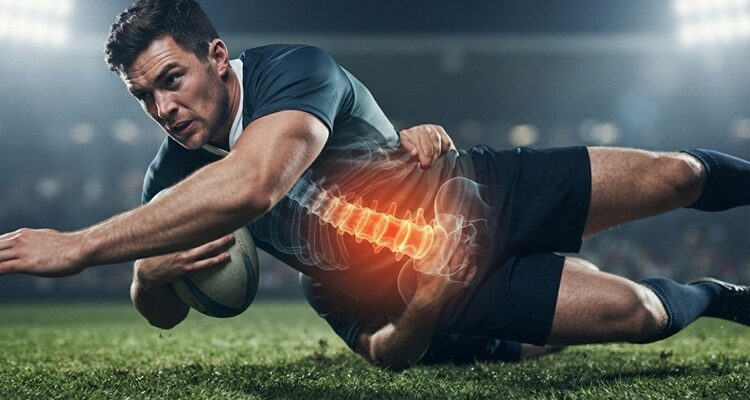
All runners, ballers, and jumpers experience it: a dull pain in the lower back after a tough day, or – worse – a shooting pain down one leg. That’s not just “tightness.” That’s your spine being smooshed with every step and jump, and if you let it go, that’s how you end up with long-term damage. Knowing what’s happening in your spine can change how you work out, recover, and treat that pain.
Table of Contents
What happens to your spine on every stride
With other connective tissues, like muscle or bone, when you work them harder, the body rebuilds them stronger (that’s how you get gains from lifting weights). With discs, that’s less the case. The cartilaginous material they’re made of isn’t supplied with the right kind of blood vessels to allow rapid, muscular regrowth. Instead, nutrients arrive via diffusion through your vertebrae. That makes the repair process slow and limits the capacity of the discs to actually fix themselves after an injury. So to protect athletes during high-impact sports or rehab from disc injuries, it’s often more a question of managing the damage they’ve done and trying to slow down the degradation process than actually reversing it.
Here is what athletes are not normally told: Intervertebral discs do not have a direct blood supply through which they can heal and rehydrate similar to how any other muscle would from the blood carrying nutrients directly to the damaged area. The discs depend on a type of hydraulic mechanism to get small amounts of fluid and nutrients pulled in and waste products pushed out.
The nucleus pulposus depends on this the most, as fluid is lost by the gel under compression – which is bad, since it’s the compression of sports training that squishes the living daylights out of the nucleus. The fluid has to be replaced when the athlete is lying down – the only way for the pump to run the other way.
Unfortunately, many athletes train hard, then sit or lie around not using the pump until it’s time to train hard again. Over time, the nucleus becomes dehydrated, the disc thins, and the vertebrae are forced closer together. This can lead to all kinds of disc and bone problems for athletes of all impacts, even swimmers for crying out loud.
When disc height drops, nerves pay the price
Diminished disc height doesn’t stay contained to the disc. As the vertebrae draw closer together, the opening where spinal nerves exit the segment narrows too. Nerve root pressure follows, and this is the point where athletes start to feel more than back stiffness. Radiculopathy is the clinical term for the numbness, tingling, weakness, or shooting pain that happens when a spinal nerve gets squeezed. Sciatica is the most common version of this, but the pattern can show up anywhere along the nerve’s path depending on which level of the spine has been affected. An athlete who feels a “hot” sensation down the back of the leg during or after training is often dealing with a nerve that has lost its normal amount of room, not a hamstring issue.
The annulus fibrosus, the tough fibrous ring around the outside of the disc, takes damage too. Repeated loading without recovery creates microtears in this structure over time. Tears don’t always cause pain right away, but they weaken the disc’s ability to contain the nucleus, setting up conditions for a herniation down the road under a single bad landing or twist.
It’s not just the discs – joints and muscles get locked up too
Pressure on the spine is not just about the intervertebral discs. The facet joints are paired joints at the back of the spinal motion segment that help guide movement and share load with the discs. Chronic compression “jams” these joints and stiffens them, so that they lose capacity for normal, healthy slide.
This, in turn, makes the segment move less effectively. If a disc and its associated facet joints are compressed, the local muscles also tighten in response to protect the segment, making the entire unit move in a more stiff and less-coordinated way. This leaves the athletic “system” inadvertently looking for more mobile segments that, many times unknowingly and unconsciously, are the hip and the knee under higher demand on landing and/or with changes in movement mechanics.
Core stability defines how much of that landing force is absorbed by muscle before it’s transmitted through the spine. Athletes with strong, well-timed, stable bracing through the trunk will send less of that impact straight through to the intervertebral discs. Athletes with poor or poorly timed bracing will be amplifying the force through their spine with each repetition.
Why rest and stretching usually aren’t enough
The natural response to a backache is to take it easy and perhaps stretch it. While this provides some relief, it doesn’t actually encourage the injured disc to reabsorb lost fluid. Muscle stretching or rest decreases the levels of stress that compress the disc, but there is no dynamic force that will lead to an increase in height of the disc, and therefore rehydration of the nucleus pulposus.
What a disc appreciates is active decompression: an uplifting separation of vertebra that takes pressure off the spongy disc and lets it suck up fluid. This is a unique mechanical process, different from the simple act of stretching or taking it easy. You need either steady traction, or a cyclical technique that gently but deliberately compresses and then decompresses the spinal segment.
The chiropractic fix: flexion-distraction and rhythmic decompression
This is how flexion-distraction technique works. Instead of a steady pull, a chiropractor employs a special table that flexes the spine forward by a gentle distraction force, then relaxes the force, and repeats this process in a rhythmic motion. This causes the space between vertebrae to open and close in a continual sequence. It’s a movement that copies the action discs take to draw in water and nutrients from the body, but it does it in a much more effective, consistent manner than bed rest.
A familiar type of this treatment is performed through ring dinger spinal decompression, which uses a mechanized flexion-distraction table to separate and unbuckle the lumbar spine. The treatment opens and closes the spinal joints and intervertebral discs. The opening widens the neural passageways, while the repeated unloading phase can help the nucleus pulposus draw in moisture. This is why patients often experience an immediate relief and feel looser in the lower back after receiving ring dinger treatment. They are experiencing the mobilization and separation of the lumbar segments in a way just pulling on the trunk can’t achieve.
Facet joints respond to the therapy because the flexion part relaxes the back muscles, including the muscles that protect the facet joint, allowing the doctor to get better joint movement and the distraction opens up the joint space and stretches some of the back muscles, helping them to become more relaxed too. The combination of increased joint movement and relaxed muscles is the key to reducing joint pain and increasing the fluid movement of the area.
What the research shows
Clinical studies on decompression therapy consistently report measurable gains for patients dealing with herniated discs or nerve root compression. Improvements typically show up across three markers: increased disc height on imaging, reduced pain scores, and better functional movement on follow-up assessment. These aren’t subjective “it feels better” reports only, they’re findings backed by objective measurement, which is part of why flexion-distraction has held up as a mainstream chiropractic treatment for decades rather than fading as a trend.
Between treatments: what athletes can do on their own
Quality care is important, but athletes aren’t helpless in their time between sessions. A couple of habits actually have a big impact on how much spinal load is managed day-to-day.
Gravity is free, and bodyweight traction is practically a hidden recovery technique for saving spinal life. A few minutes hanging passively from a bar or an inversion setup gives the spine some nice decompression that can be particularly useful post-training when the spinal compressive load has just been driven way up.
Speaking of which, the same amount of real long-hold post-exercise decompression probably does a lot more than many athletes think. Discs get soaked with fresh fluid in states of non-compressive rest, so a period of ten minutes with hips and knees both at 90° (not just lying on the back) can be quite useful after a run or a practice to really give those discs an unloading window instead of letting training end and then squishing the snot out of them by sitting in the car or at a desk.
Landing mechanics are the kind of small hourly factor that really does start to add up over a year or a career. A coach or PT working with an athlete can usually clean up their landing stance in just a few minutes. Stiff-leg landers are almost always committing their lumbar spines to maximum-force acceptance roles while athletes who land with soft knees and active hip/ankle absorption do a great deal to disperse that force away from the lumbar spine and through muscle and connective tissues.
When to stop self-managing and get evaluated
The majority of compression-related stiffness and mild nerve irritation will improve in response to professional treatment and the habits outlined above. However, the following symptoms should not be ignored in the hopes that they, too, will resolve:
- Progressive Leg Weakness: Especially if the weakness is increasing day by day, you need to see a clinician right away. The nerve is becoming more and more inflamed and injured, and sooner or later the weakness will become permanent. Don’t go there.
- Loss of Bowel or Bladder Control: This is a medical emergency. Get yourself to the emergency room.
- Unrelenting Nerve Pain: If your pain is severe and not relieved by positions of comfort and sufficient rest, seek help.
In each of these cases, the nerve is on fire. Nerves are not happy in that condition, and it can lead to irreversible damage if the problem isn’t resolved.
Spinal compression from high-impact sport isn’t something that resolves on its own with time and ice. Discs need active decompression to rehydrate, joints need mobilization to regain glide, and athletes need better mechanics to reduce the load hitting the spine in the first place. Treat all three, and the stiffness that seemed like a normal part of training starts to disappear instead of building toward the next injury.











Comments